
 9 Oct 2026
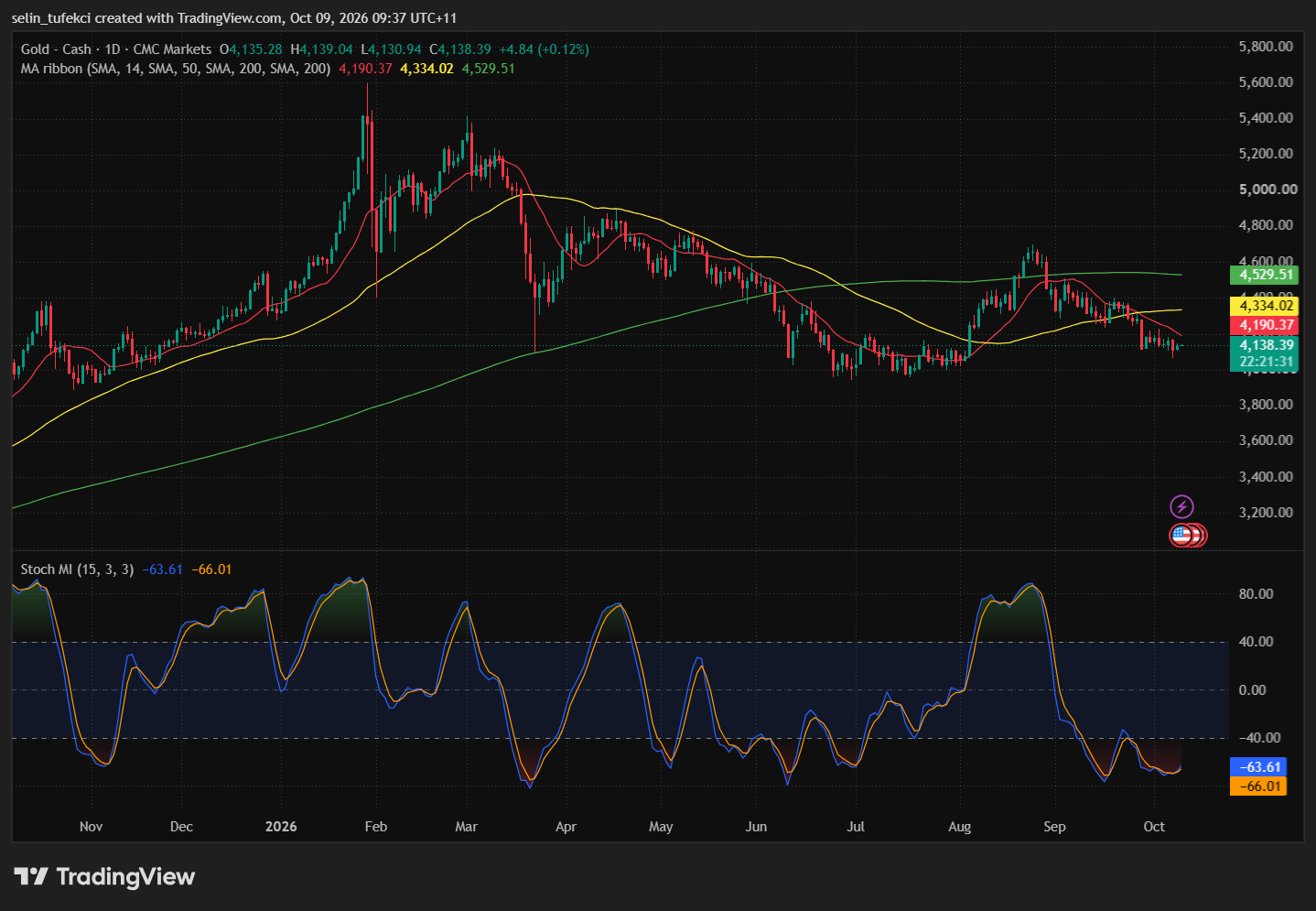
 Daily Chart: Longer-Term Bias: Bearish
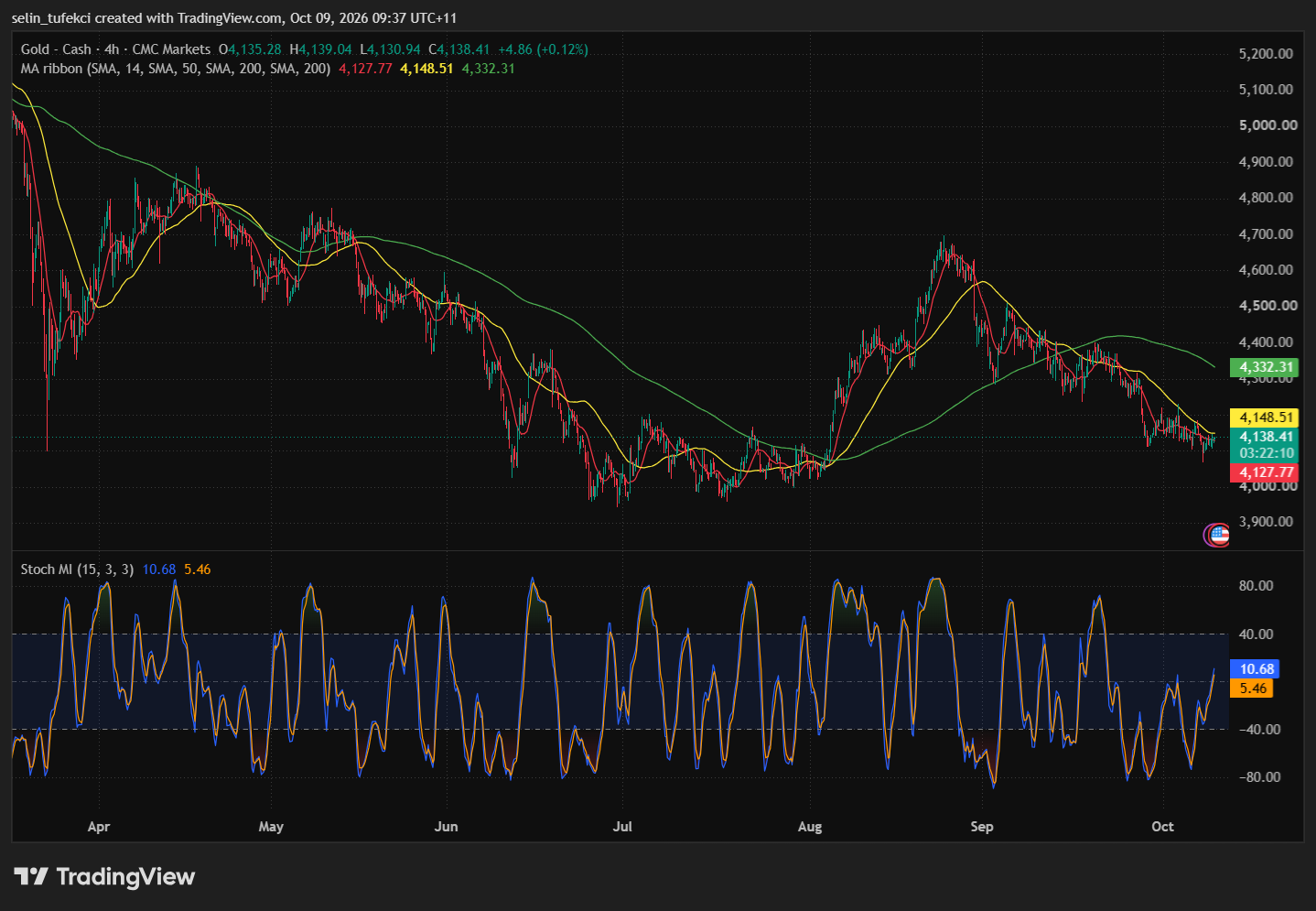
4-Hour Chart: Short-Term Outlook: Neutral
Friday 9th October
The daily chart keeps a bearish longer-term bias. Gold at 4,138 trades below all three moving averages, and the structure since the January peak near 5,600 is a clear series of lower highs: roughly 5,420 in March, 4,850 in April and 4,700 in late August. The 50-day moving average (yellow) at 4,334 crossed below the 200-day moving average (green) at 4,529 in early June, which is a “death cross.” That crossover signals that medium-term momentum has turned weaker than the long-term trend, and the August rally confirmed it when it stalled just above the flattening 200-day line and then rolled over. The 14-day moving average (red) at 4,190 is now acting as dynamic resistance, meaning it marks the level where recent rebounds have been sold. It is the first hurdle, with the 50-day at 4,334 the more important ceiling. On the downside, the recent low near 4,090 is immediate support, followed by the 3,960–4,000 zone. That zone held price repeatedly through late June and July and forms the base of the year’s range, so a break below it would open a deeper leg lower. The Stochastic Momentum Index is deep in oversold territory at -63.61 (signal line -66.01), and the two are on the verge of a bullish crossover. More significantly, price has made a lower low near 4,090, while the SMI’s trough is higher than its mid-September low near -85. This is a bullish divergence: selling pressure is losing intensity even as price slips, which often comes before a relief bounce. That divergence argues against chasing shorts at current levels. A better approach is to sell rallies into the 4,190–4,334 resistance band. The downside target is 3,960, the July base, and a stop loss belongs above 4,345, just over the 50-day moving average. A daily close above that level would neutralise the bearish structure.
The 4-hour chart warrants a neutral short-term outlook because two signals now conflict: a still-intact downtrend and building upside momentum. Price has made lower highs since the late-August peak near 4,700, at roughly 4,500, 4,400 and then 4,220 in early October. The 200-period moving average (green) at 4,332 is sloping down well above price, which confirms the broader short-term trend is still down. However, price has just reclaimed the 14-period moving average (red) at 4,128 and is pressing against the 50-period moving average (yellow) at 4,149. These two averages have converged into a tight band, a compression that typically comes before a directional breakout. The Stochastic Momentum Index has climbed from oversold readings to 10.68, with its signal line at 5.46, so the bullish crossover is confirmed. It also shows a bullish divergence: price lows have stepped down from about 4,120 in early October to about 4,090 this week, while the SMI lows have stepped up from near -80 to around -35. This tells us the latest push lower lacked momentum and buyers are absorbing supply. A 4-hour close above 4,150 would confirm the divergence and target the 4,220 swing high. Beyond that, the declining 200-period average near 4,330 is the upper objective, and it also matches the daily 50-day line. The SMI is approaching its +40 overbought threshold, though, so the rebound may have limited room before it needs to consolidate. Traders looking to play the bounce can enter on a confirmed break above 4,150, with a stop loss below 4,085, under the recent swing low. If price fails at 4,150 and breaks below 4,090, the bullish divergence is invalidated and the 4,000 support zone comes into play.
Daily Chart: Longer-Term Bias: Bearish
4-Hour Chart: Short-Term Outlook: Neutral
Thursday 8th October
The daily chart shows a bearish longer-term bias. Gold, at 4,108, trades below all three moving averages, and they are stacked in bearish order: the 14-day at 4,203 (red) sits below the 50-day at 4,331 (yellow), which sits below the 200-day at 4,530 (green). This alignment shows that short-, medium- and long-term momentum all point lower, and each average now acts as overhead resistance rather than support. The structure confirms it. After peaking near 5,500 in late January and failing to retake that high in March, gold has formed a sequence of lower highs. The August recovery stalled at roughly 4,700, just above the 200-day moving average, and the September decline then broke back below both the 50-day and 14-day averages. That failure at the 200-day is significant because it shows sellers still defend the long-term trend gauge. The Stochastic Momentum Index (SMI) is at –71.42, with its signal line at –70.43. That is deep in oversold territory, meaning price is trading near the bottom of its recent range and downside momentum is stretched. The SMI also shows a developing bullish divergence: price has made a lower low near 4,103, while the SMI’s current trough is shallower than its late-September low near –80. This suggests selling pressure is fading even as price slips, which raises the risk of a relief bounce. However, the divergence is unconfirmed until the SMI crosses above its signal line and price reclaims the 14-day average. Immediate support is the psychological 4,000 level, which also marks the floor of the June–July base. Below that, 3,950 marks the base’s lowest lows, and a daily close beneath it would expose a deeper extension of the downtrend. Resistance sits first at the 14-day average at 4,203, then at the 50-day average at 4,332. Under this bias, rallies toward 4,203 to 4,332 favour short positioning, with a downside target of 4,000 and an extended target of 3,950. A stop loss above 4,340 sits just beyond the 50-day average. A sustained close above that level would invalidate the bearish view and turn the bias neutral, with the 200-day at 4,530 the next upside reference.
The 4-hour chart gives a more neutral short-term outlook. Price has been compressing in a tight range of about 4,080 to 4,210 since the start of October, after a steep September decline. All three moving averages remain overhead: the 14-period at 4,132, the 50-period at 4,155 and the 200-period at 4,347, with the 200-period sloping clearly lower. The 14- and 50-period averages are converging just above price, which means each rebound attempt keeps hitting resistance from short-term trend-followers. That capping pattern explains why the lower highs have persisted. The SMI reads –30.62, just above its signal line at –31.47. It is recovering from oversold levels and has started a fresh bullish crossover. It has also formed successively higher troughs in early October while price held roughly equal lows near 4,080 to 4,090. This is a mild bullish divergence, signalling that downside momentum is weakening and that sellers are struggling to push the market to new lows. That divergence offsets the bearish moving-average structure and is why the short-term outlook is neutral rather than bearish, although the trend has not yet reversed. Immediate resistance is the 50-period average at 4,155, followed by the range top near 4,210. A break above 4,210 would confirm the divergence and open a move toward the 200-period average at 4,347. Support is at the range floor of 4,080, then the 4,000 psychological level, which aligns with the daily support. Traders may prefer to wait for the range to resolve. A close above 4,160 favours long positions toward 4,210 and then 4,347, with a stop loss below 4,080. A breakdown below 4,080 would invalidate the divergence and realign the 4-hour chart with the bearish daily trend, targeting 4,000 with a stop loss above 4,160.
Wednesday 7th October
The daily chart shows a bearish longer-term bias. Gold closed at 4,165.53, below all three moving averages: the 14-day (red) at 4,226.40, the 50-day (yellow) at 4,332.64, and the 200-day (green) at 4,531.71. A market trading under all three averages, with the shorter averages below the longer ones, is in a confirmed downtrend. Each average now sits overhead as dynamic resistance where sellers have previously defended rallies. The structure since the March peak above 5,400 is a series of lower highs. The August rally reached roughly 4,700 and briefly pierced the 200-day, but it failed and rolled back under that average. That failure is a classic bearish signal because the 200-day is the line institutions use to separate long-term bull and bear regimes. The 50-day has also stayed below the flattening 200-day since the late-May bearish crossover, and the 14-day has just slipped back under the 50-day, so short-, medium- and long-term trend measures all point the same way. The Stochastic Momentum Index, which measures where the close sits relative to the midpoint of its recent high-low range, reads -66.03 against a signal line of -67.51. That places it deep in oversold territory below -40. It also shows a modest bullish divergence: price has made a lower low near 4,120 while the SMI has formed a higher trough than its mid-September low near -75. The blue line is also curling just above the orange signal line. This divergence means downside momentum is fading even as price slips lower. It does not reverse the trend, but it warns that fresh shorts at current levels carry poor risk-reward and that a relief bounce toward the 14-day average at 4,226 is likely before the downtrend resumes. The preferred approach is to sell rallies that stall between 4,226 and 4,332, with a stop loss above 4,340, just beyond the 50-day average. The first downside target is the recent swing low at 4,120. A daily close below it would open the June–July base around 3,960–4,000, where buyers previously absorbed selling for over a month. Two closes above 4,332 with a confirmed SMI bullish crossover would neutralize the bearish bias and point toward a retest of the 200-day near 4,530.
The 4-hour chart shows a neutral short-term outlook: a corrective bounce inside a broader downtrend. Price at 4,165.48 has reclaimed the 14-period average (red) at 4,146.97 and is now pressing against the 50-period average (yellow) at 4,175.56. The 200-period average (green) at 4,361.08 is sloping lower well above price. The 50-period crossed below the 200-period in mid-September, and that bearish crossover produced the sell-off from the 4,400 area into the 4,120 low. As long as price stays below the falling 50-period average, rallies remain counter-trend. The momentum picture is more constructive. The SMI has bounced from roughly -70, which was a higher trough than the late-September low near -80. It now reads -8.13, well above its signal line at -20.62. Meanwhile price has held above the 4,120 low. Higher momentum lows paired with stable price lows show that short-term selling pressure is drying up, so a test of overhead resistance is likely. However, the SMI is approaching the zero line, where the early-October bounce stalled. A rejection there would form a lower momentum high and confirm the bounce as a bear-market rally. The immediate pivot is the 50-period average at 4,176. A failure there, especially with the SMI turning down below zero, favors shorts aligned with the daily bias. In that case, use a stop above 4,230 and target 4,147 first, then the 4,120 swing low. A sustained 4-hour close above 4,176, followed by a break of the 4,190 bounce high, would extend the recovery toward 4,300. That level is the late-September breakdown shelf, and former support often turns into resistance. Beyond it lies the 200-period average at 4,361. Long positions on that breakout should use a stop below 4,140, under the 14-period average and just above the swing low, since losing 4,120 would confirm a fresh lower low and resume the downtrend toward 3,960.
Tuesday 6th October
The daily chart has turned bearish over the longer term. Gold trades at 4,135, below all three moving averages, and the averages are stacked in a bearish order. The 14-day sits at 4,237, the 50-day at 4,330, and the 200-day at 4,532. That stacking is significant because the 50-day crossed beneath the 200-day in early summer, a “death cross” that usually marks a shift from an uptrend to a downtrend. The late-August rally made the case stronger. It peaked near 4,700 but failed to hold above the flattening 200-day average. Since then the market has made a series of lower highs, around 4,500 in early September and 4,400 in mid-September, and the latest leg has broken below the 50-day as well. The 50-day was acting as dynamic support, so losing it turns that level into overhead resistance. The 14-day at 4,237 is now the first barrier for any recovery, and the 50-day at 4,330 is the more important ceiling. The Stochastic Momentum Index reads −75.24 against its signal line at −71.97. It is deep in oversold territory, and the blue line remains below the orange, which confirms that bearish momentum is still active. There is a tentative bullish divergence worth watching, however. Price has fallen below its mid-September trough, while the SMI has made a roughly equal or marginally higher low near −75 to −78. This suggests downside momentum is weakening even as price slips, so the decline may slow or pause, but the divergence is not confirmed until the SMI crosses above its signal line and climbs back above −40. Until then, the trend structure takes priority. Bears can target the 4,100 area first and then the psychologically important 4,000 level, which also marks the upper edge of the June–July base where gold found demand repeatedly. A stop loss above the 50-day average at 4,330 protects against a divergence-driven rebound that reclaims the moving-average cluster. A daily close above that level would neutralise the bearish bias and open the way back toward 4,400.
The 4-hour chart confirms the bearish short-term trend. Price at 4,134.51 sits below the 14-period average at 4,155, the 50-period at 4,190, and the 200-period at 4,371, and all three are sloping lower in a textbook bearish alignment. This tells us that sellers control the short, medium, and longer intraday horizons at the same time, and that every rally into the averages is being sold. The pattern showed clearly in the most recent bounce. Price recovered from the early-October low near 4,110, met the declining 50-period average around 4,190, and was rejected immediately. That rejection makes 4,190 the key short-term pivot, with the 14-period at 4,155 acting as the first cap. On the Stochastic Momentum Index, the latest swing is important. The SMI rallied to roughly the zero line, failed to reach overbought territory, and has now rolled over to −69.65 against a signal line of −65.47. A momentum bounce that stalls at the midline in a downtrend is a classic sign of a weak, corrective rally rather than a reversal, and the bearish crossover adds to the downside pressure. There is a mild bullish divergence across the late-September and early-October lows: price stepped slightly lower while the SMI troughs held near −80. This hints that selling pressure is fading at the extremes, which matches the oversold daily reading, so traders should expect choppy, two-way action near support rather than a straight-line decline. Even so, the divergence remains unconfirmed while the SMI trends lower beneath its signal line. Short positions favour an initial target at the 4,110 swing low, and a break below it would expose 4,020, near the late-July consolidation base where the August rally began. A stop loss above 4,200, just beyond the 50-period average, is recommended. A sustained move above that level, together with an SMI cross back above zero, would signal that the divergence is taking hold and that a short-covering rally toward 4,250 to 4,300 is under way.
Monday 5th October
The daily chart has a bearish longer-term bias. Gold at 4,145 trades below all three moving averages, and they are stacked in bearish order: the 14-day (red) at 4,246, the 50-day (yellow) at 4,328, and the 200-day (green) at 4,534. That stacking means short-, medium- and long-term buyers are all holding losses, which tends to turn rallies into selling opportunities. The 50-day crossed below the 200-day in late May and early June, a “death cross” that signalled the shift from the January–March uptrend into a broader corrective phase. Since then the market has made lower highs: the late-February peak near 5,400, the April high near 4,850, and the late-August rally that stalled near 4,700, just above the 200-day average. Since that rejection, price has slid back through the 50-day and 14-day averages. The early-October breakdown below the September consolidation near 4,250 makes 4,246 the first resistance, since the 14-day average and broken support now coincide there. Above that, 4,328 at the 50-day average is the more important ceiling. On the downside, 4,100 is immediate support, a psychological round number near the late-March wick low. Below it, 3,950–4,000 is the June–July base that launched the August rally, and the most likely destination if 4,100 gives way. The Stochastic Momentum Index (SMI) is deeply oversold at -70.55, with its fast line below the signal line at -68.31, which confirms that downside momentum is still in control. There is a tentative bullish divergence, though: price has made a lower low below the mid-September trough, but the SMI is holding slightly above its mid-September low near -75. That suggests selling pressure is weakening even as price slips. The divergence is only a warning until the SMI crosses back above its signal line and leaves the oversold zone, so for now it argues against chasing shorts at current levels rather than for buying. The preferred approach is to sell rallies toward 4,246–4,328, targeting 4,100 and then 3,950, with a stop loss above 4,340, just over the 50-day average. A daily close back above that level would neutralize the bearish structure and open a retest of the 200-day average near 4,534.
The 4-hour chart also has a bearish short-term outlook, with price at 4,145 below the 14-period average at 4,165, the 50-period at 4,211 and the 200-period at 4,379. The 50-period average crossed below the 200-period in mid-September, confirming the downtrend from the late-August high near 4,700. Since then, the 14-period average has repeatedly capped bounces, which is typical of a market where sellers defend the fastest average. Price has been basing in a narrow 4,120–4,170 range over the past several sessions. Immediate resistance sits at 4,165 (the 14-period average), followed by 4,211 (the 50-period average), which also marks the lower edge of the late-September breakdown zone. Support is at 4,120, the recent swing low, and then 4,050, an intermediate shelf above the July base. On momentum, the SMI bounced to around zero and then rolled over, with the fast line at -46.17 crossing below the signal line at -33.89. That bearish crossover below the midline points to renewed downside pressure in the near term. The divergence picture matters here as well. In late September, price fell to roughly 4,130 while the SMI dropped near -80. If price now retests or slightly undercuts 4,120 while the SMI stays well above that -80 low, it would form a bullish divergence: declining momentum into a new price low, often a precursor to a short-covering bounce. Until that happens, the bearish crossover and the moving-average structure keep the short-term bias pointing lower. Traders can look to sell bounces toward 4,165–4,211, targeting 4,120 first and then 4,050, with a stop loss above 4,220, just over the 50-period average. A sustained move above that level, especially alongside a confirmed SMI divergence, would signal a short-term reversal toward the 4,280–4,300 September congestion zone.
Friday 2nd October
The daily chart shows gold in a broad corrective downtrend since the twin peaks near 5,500 in late January and around 5,400 in early March. The market has since printed a series of lower highs, first near 4,850 in April and then near 4,700 in late August. The August rally briefly pushed above the 200-day moving average (green line, now 4,536) but could not hold there. That failed breakout turned the 200-day into a ceiling and confirmed that sellers are defending the longer-term trend. Price now trades at 4,161, below all three moving averages, which sit in fully bearish order: the 14-day at 4,258 is below the 50-day at 4,327, which is below the 200-day at 4,536. This kind of stacking means short-, medium- and long-term average prices are all falling in sequence, and each average tends to act as resistance on rallies. The 50-day also crossed below the 200-day in early June, a “death cross” that signals the medium-term trend has turned weaker than the long-term trend. The late-September break below the 50-day, which had briefly supported price, ended the recovery attempt that began in August. Immediate resistance sits at the 14-day average at 4,258, followed by the 50-day at 4,327, a zone that capped the mid-September bounce. On the downside, the first target is 4,100, which held as the March wick low and later marked the top of the July consolidation base. Below that, the main target is the June–July floor near 3,960. The Stochastic Momentum Index (SMI) measures where the close sits relative to the midpoint of the recent high-low range, and readings below -40 indicate oversold conditions. The SMI currently reads -64.28 against its signal line at -64.36, which is clearly oversold. Price has also made a lower low beneath its mid-September trough, while the SMI has held above its prior trough near -75. That is an early bullish divergence: downside momentum is fading even as price slips lower, which often comes before a relief bounce. However, the divergence is not confirmed. The SMI lines are flat and essentially overlapping, with no decisive bullish crossover, so the bearish moving-average structure still sets the bias. Traders favouring the downside can target 4,100 and then 3,960, with a stop loss above the 50-day at 4,330 to guard against a divergence-driven rebound. A daily close back above 4,330 would neutralise the bearish view and expose the 200-day near 4,536.
The 4-hour chart shows a clean descending structure from the late-August high near 4,700. Successive lower highs formed near 4,580, 4,420 and 4,400, followed by steadily lower lows, the textbook definition of a short-term downtrend. Price at 4,161 is pinned just under the 14-period moving average (red line) at 4,170, which is now acting as immediate dynamic resistance. The 50-period average (yellow line) at 4,232 has sloped decisively lower and has rejected every bounce since mid-September. The 200-period average (green line) at 4,385 has also rolled over after price broke below it in late September. When the slowest average starts turning down, the intermediate trend has shifted from up to down, which strengthens the case for selling rallies rather than buying dips. Momentum confirms this bias. The SMI recovered from deeply oversold readings near -80 in late September, but the bounce stalled just below the zero line. The SMI (-16.95) has now crossed back below its signal line (-12.41), a bearish crossover that shows the corrective bounce has lost steam. A failure below zero tells you that even the recovery attempt could not shift momentum into positive territory. Traders should still watch for divergence. If price breaks below the recent swing low near 4,140 while the SMI holds well above its prior -80 trough, that bullish divergence would warn that selling is exhausting and the downside would likely be limited. Without that signal, a break of 4,140 opens the way toward 4,100 and then the early-August base around 4,050. That base was the launch point of the last major rally, so it is the area where buyers are most likely to defend. Short positions taken on rallies toward 4,200–4,230 offer favourable risk, targeting 4,140 and then 4,050, with a stop loss above the 50-period average at 4,240. A sustained move above 4,240 would invalidate the short-term bearish view and point to a retest of the 200-period average near 4,385.