
EUR/USD
 16 Oct 2026
EUR/USD: 4-hourly and daily chart technical view
Daily Chart: Longer Term Bias: Bearish
| Resistance |
1.1280 then 1.1340 |
| Support |
1.1150 then 1.1110 |
4-Hour Chart: Short-Term Outlook: Neutral
| Resistance |
1.1240 then 1.1280 |
| Support |
1.1190 then 1.1115 |
Daily Chart: Longer-Term Bias: Bearish
4-Hour Chart: Short-Term Outlook: Neutral
Friday 16th October
The daily chart has a bearish longer-term bias. EUR/USD has fallen steeply from the mid-September high near 1.1650 to a fresh low around 1.1110 this week, and on the way down it broke decisively through the June–July support base at 1.1330–1.1360. Under the principle of polarity, broken support tends to act as resistance on any retest, so that former floor at 1.1340 is now a ceiling. The pair trades below all three moving averages: the 14-day SMA (red line) at 1.1230, the 50-day SMA (yellow line) at 1.1469 and the 200-day SMA (green line) at 1.1584. All three are declining, and the 50-day has been below the 200-day for months. That bearish alignment, with shorter averages under longer ones and everything sloping down, confirms sellers are in control on every horizon. The 14-day SMA has capped every bounce since mid-September and is the first dynamic resistance. The Stochastic Momentum Index (SMI) measures where the close sits relative to the midpoint of the recent high-low range, with readings below −40 oversold and above +40 overbought. It has been deeply oversold near −80 since late September. That reflects how persistent the selling has been, but it also creates the conditions for a relief rally. Price made a lower low this week, while the SMI held at roughly the same trough and has now turned up. The SMI (blue line) is at −51.85 above its signal line (orange) at −61.10, a bullish crossover. This mild bullish divergence shows downside momentum is no longer accelerating, so a corrective bounce toward 1.1280 or even the 1.1340 broken support is possible before the downtrend resumes. The divergence does not reverse the bias, but it argues against chasing shorts at current levels. A better approach is to sell rallies into the 1.1280–1.1340 resistance zone, targeting 1.1110 and then the 1.1050 psychological level, with a stop loss above 1.1350. A daily close above 1.1350 would mean the pair has reclaimed its broken support and would open a deeper recovery toward the 50-day SMA near 1.1470.
The 4-hour chart has a neutral short-term outlook. EUR/USD has been consolidating in a 1.1115–1.1280 range since early October, and the sharp rebound from this week’s spike low near 1.1115 has pushed price back into the middle of that range. Price at 1.1219 sits just above the 14-period SMA (red line) at 1.1193 and the 50-period SMA (yellow line) at 1.1200. Both averages have flattened after weeks of decline, and price is now holding above them, which shows short-term selling pressure has eased and the 1.1190–1.1200 cluster has become the first support zone. The 200-period SMA (green line) at 1.1407 is still falling steeply and well above price, a reminder that the broader short-term trend remains down and any rally is a counter-trend move until that average is challenged. The SMI (blue line) has surged to 58.40 above its signal line (orange) at 53.14, in overbought territory above +40, and it is the strongest momentum reading on this timeframe since early September. This rebound in momentum is more forceful than the early-October bounce, even though price is still below that bounce’s high near 1.1280. Momentum outpacing price like this is constructive and suggests buyers may test the top of the range. Because the SMI is already overbought as price approaches the 1.1240–1.1280 resistance band, however, the upside may be limited and a pause or pullback is likely there. A 4-hour close above 1.1280 would break the range to the upside and target 1.1340 and then the 200-period SMA near 1.1400, with a stop loss below 1.1185. A rejection from 1.1240–1.1280 would line up with the bearish daily bias and offer a selling opportunity, targeting 1.1150 and then 1.1115, with a stop loss above 1.1290.
Daily Chart: Longer-Term Bias: Bearish
4-Hour Chart: Short-Term Outlook: Neutral
Thursday 15th October
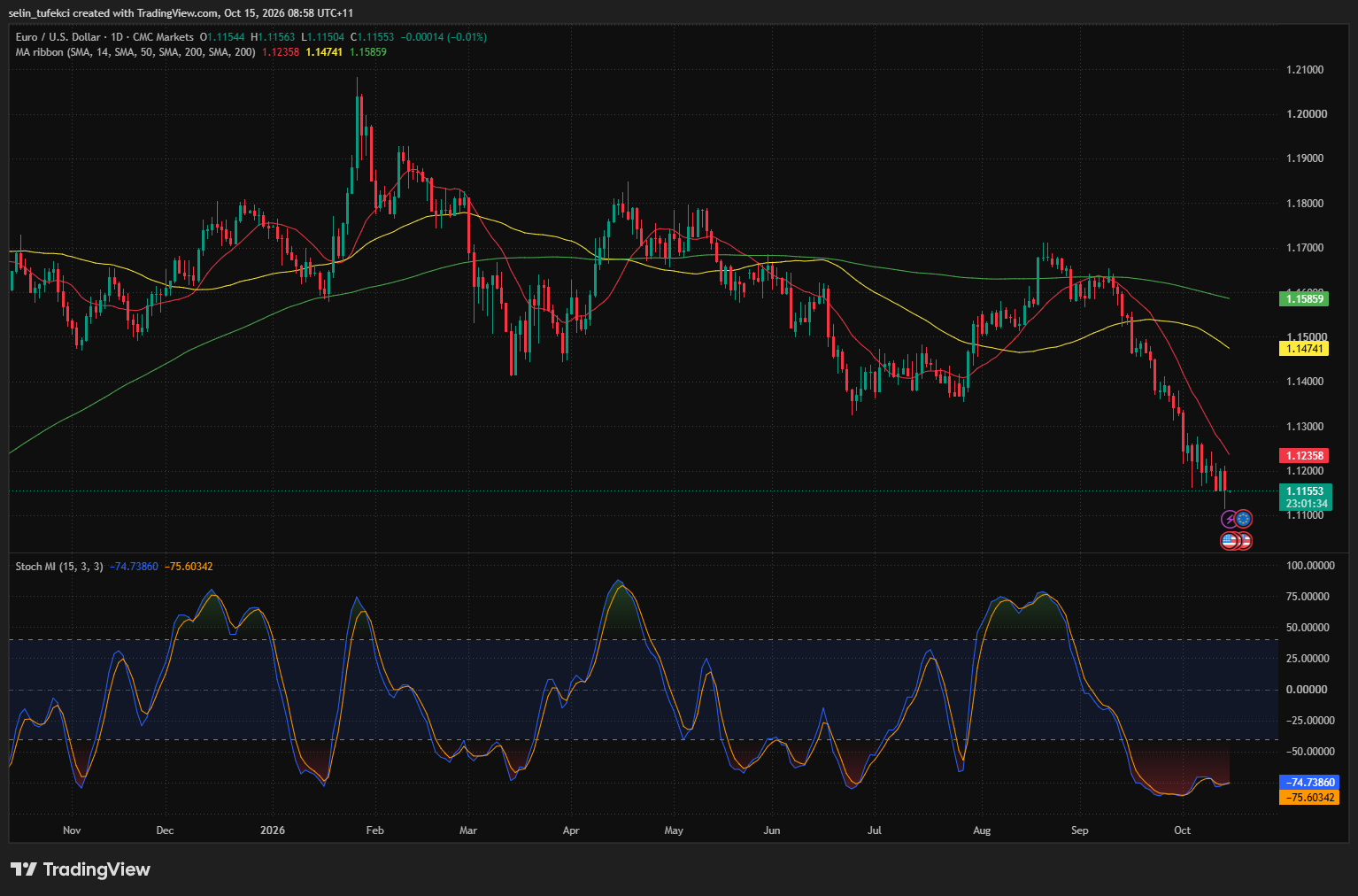
The daily chart keeps a firmly bearish longer-term bias. EUR/USD is trading at 1.1155, its lowest level on the chart, below all three moving averages, and all three are sloping down. The 14-day moving average (red line) at 1.1236 has guided the decline from early September and is the first resistance on any rebound. The 50-day moving average (yellow line) at 1.1474 is falling below the 200-day moving average (green line) at 1.1586. That bearish alignment means short-, medium- and long-term trend followers are all positioned short, so rallies tend to be sold. The sell-off from the late-August high near 1.1710 has been steep and persistent: price broke the 1.1330 June low and then moved into a tight 1.1160–1.1280 consolidation in early October. That pause is resolving lower, with this week’s dip to about 1.1110 setting a fresh low. The next support sits at that 1.1110 low, followed by the 1.1000 psychological level. The Stochastic Momentum Index (SMI) is the main reason not to chase the move. It has been pinned in deeply oversold territory near -75 for about three weeks. The late-September SMI trough near -82 was deeper than the current reading, even though price has since made lower lows. This mild bullish divergence shows downside momentum is slowing, and extended oversold readings like this often end in a sharp short-covering bounce. However, the SMI has not made a bullish crossover and price remains below every average, so the divergence is a warning rather than a reversal signal. Traders can favour selling rallies toward the 14-day average at 1.1236, targeting 1.1110 and then 1.1000. A stop loss belongs above 1.1280, the top of the early-October range, since a close above it would confirm the divergence and signal a broader corrective rally.
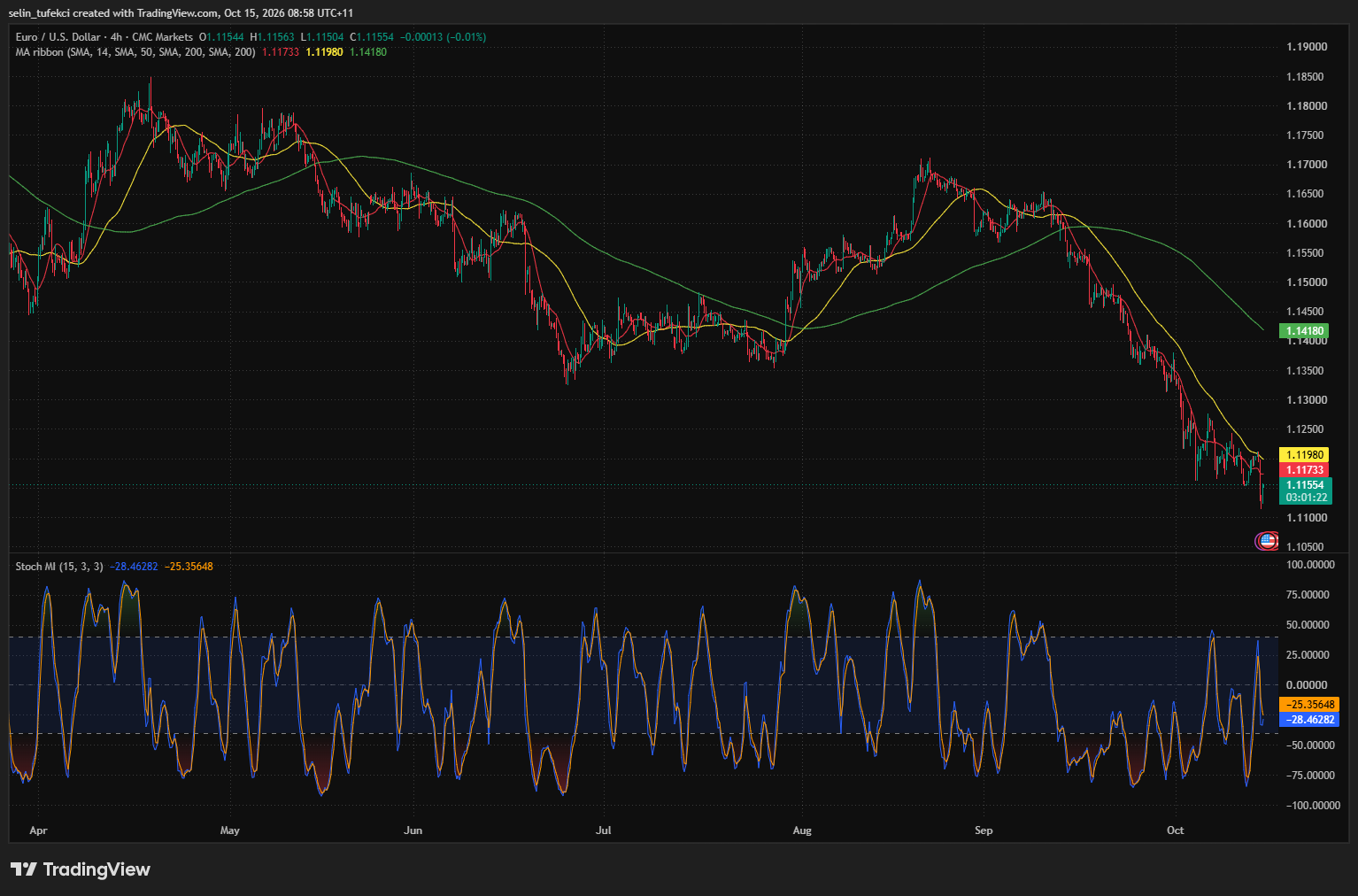
The 4-hour chart also shows a bearish short-term outlook, though the latest price action hints at exhaustion. The pair is trading at 1.1155 below the 14-period moving average (red line) at 1.1173 and the 50-period moving average (yellow line) at 1.1198, with the 200-period moving average (green line) far above at 1.1418 and falling steeply. The 50-period average has capped every rebound since mid-September, including this week’s high near 1.1215. That makes the 1.1173–1.1198 zone the key resistance band, where sellers have repeatedly defended the downtrend. The latest 4-hour candles dipped to about 1.1115 and left a long lower wick, showing buyers stepped in at the lows. The SMI supports that reading. Price made a lower low at 1.1115, below the October 9 low near 1.1160, but the SMI is only at -28 compared with a trough near -80 at the earlier low. This bullish divergence suggests the latest push lower lacked momentum and raises the odds of a short-term bounce toward the moving-average resistance. Because price remains below both shorter averages and the broader structure is still a sequence of lower highs and lower lows, any bounce should be treated as a selling opportunity rather than a trend change. The preferred approach is to sell a recovery into 1.1173–1.1198, targeting 1.1110 first and then 1.1050 on a break of this week’s low. A stop loss above 1.1225, just over the recent swing high, protects against a stronger short-covering rally. A 4-hour close above 1.1225 would confirm the divergence and open a move toward 1.1280.
Wednesday 14th October
The daily chart has a firmly bearish longer-term bias. EUR/USD is trading at 1.1197, well below all three moving averages: the 14-day SMA (red) at 1.1256, the 50-day SMA (yellow) at 1.1482 and the 200-day SMA (green) at 1.1589. The averages are stacked in bearish order, with the short-term below the medium-term below the long-term, and all three are sloping lower. This alignment shows sellers in control across every timeframe the averages measure, so any rally toward them is likely to meet supply. The 50-day crossed below the 200-day in the summer, a “death cross” that signalled the medium-term trend had turned weaker than the long-term trend. Since then the pair has made a clear sequence of lower highs, from 1.2080 in late January to about 1.1850 in April, about 1.1710 in late August and about 1.1650 in September. The September–October decline has been especially forceful. It cut through the late-June and late-July lows near 1.1330–1.1360, which had been the floor of the year’s range, and that broken support now becomes resistance, a principle known as polarity. Immediate resistance is 1.1275, the early-October rebound high, followed by 1.1330, the former June low. Support is first at the October low near 1.1150 and then at the psychological 1.1100 level. The Stochastic Momentum Index (SMI) reads -75.32 with its signal line at -75.98. It has been pinned in deeply oversold territory for about three weeks and has just edged above its signal line. An early, tentative bullish divergence is forming: the SMI bottomed near -82 in late September and early October and has since lifted slightly, while price has pushed to marginally lower lows near 1.1150. This suggests the pace of selling is slowing and that a corrective bounce or sideways pause is possible. It is not yet evidence of a trend reversal, especially with price so far below the falling moving averages. In practice, the divergence argues against chasing shorts at current depressed levels. A relief rally into the 1.1275–1.1330 resistance zone would offer a better-risk opportunity to sell in line with the downtrend. The downside target is 1.1100, and a break there would open further losses toward 1.1050. A stop above 1.1340, just beyond the former June low, aligns with the bearish bias, because a sustained recovery above that level would mean the breakdown had failed.
The 4-hour chart shows a bearish short-term outlook, although price is attempting a minor recovery from the October low. EUR/USD is trading at 1.1198, just above the 14-period SMA (red) at 1.1182 but below the 50-period SMA (yellow) at 1.1209 and well below the steeply falling 200-period SMA (green) at 1.1431. The 50-period average has capped every rebound since mid-September, including the early-October bounce that stalled near 1.1275. That makes it the key dynamic resistance defining the short-term downtrend. The wide gap between price and the 200-period average reflects how extended the sell-off has been, and it also shows how far the pair would have to rally to repair the trend. Immediate resistance is 1.1210 at the 50-period SMA, followed by 1.1275, the early-October swing high. Support is first at 1.1180, where the 14-period SMA sits, and then at the October low near 1.1150. The SMI has surged from about -82 to 5.21 and crossed above both its signal line at -11.76 and the zero line. This reflects a sharp short-term momentum recovery as the pair bounces off its lows. However, there is no bullish divergence to support a lasting reversal. The SMI’s latest trough near -82 was lower than its early-October trough near -75, matching price’s lower low, so momentum confirmed the downtrend rather than diverging from it. That makes the current SMI rally look like a relief bounce within a falling market. A move toward the +40 overbought threshold while price tests the 1.1210–1.1275 resistance would set up a favourable short entry. The downside target is the 1.1150 low and then 1.1100. A stop above 1.1280, just beyond the early-October swing high, protects the short-term bearish view, because a break there would mean buyers had overcome the 50-period average and established the first higher high since September.
Tuesday 13th October
The daily chart shows a bearish longer-term bias, as EUR/USD stays in a steep, well-defined downtrend and has fallen to its lowest level in more than a year. The pair is trading at 1.1157, well below all three moving averages. The averages are stacked in bearish order: the 14-day SMA (red line) at 1.1266 is below the 50-day SMA (yellow line) at 1.1489, which is below the 200-day SMA (green line) at 1.1591, and all three are now sloping lower. The 50-day has been below the 200-day since June, a “death cross” that signals the medium-term trend has turned down relative to the long-term trend. The rejection at the 200-day SMA in early September started the current sell-off. Since then, price has sliced through the June and July lows around 1.1330 to 1.1390 without a meaningful bounce, and that former support zone should now act as resistance. The 14-day SMA has capped every rally attempt along the way, confirming it as dynamic resistance. The Stochastic Momentum Index (SMI), which measures where the close sits relative to its recent high-low range, has been deeply oversold below -75 since late September. In a strong trend, oversold readings can persist for weeks, showing that sellers are in firm control rather than signalling an immediate reversal. There is a tentative bullish divergence, as price has made a fresh low while the SMI is at -84.42, slightly above its late-September trough near -88. However, this is not confirmed: the blue SMI line has just turned back below the orange signal line at -79.80, a bearish crossover that shows downside momentum is reasserting itself. Resistance comes first at the early-October bounce high and 14-day SMA near 1.1270, then at the former July support around 1.1390. Support sits at the psychological 1.1100 level, then at 1.1000. Traders can look for short positions on rallies toward 1.1270, targeting 1.1100 and then 1.1000, with a stop loss above 1.1280. A bullish SMI crossover combined with a daily close above the 14-day SMA would confirm the divergence and signal that a corrective bounce toward 1.1390 is under way.
The 4-hour chart shows a bearish short-term outlook, as price has broken below the recent consolidation floor with momentum firmly confirming the move. EUR/USD is trading at 1.1157, below the 14-period SMA (red line) at 1.1191, the 50-period SMA (yellow line) at 1.1218 and the 200-period SMA (green line) at 1.1444. All three averages are falling in bearish order, and the 50-period has guided price lower throughout the decline from the September high near 1.1650. Since early October, the pair had been consolidating between roughly 1.1160 and 1.1280. The latest rally attempt stalled near 1.1240, below the 50-period SMA, and price has now slipped beneath the 1.1160 floor. A break of consolidation support in the direction of the main trend is a continuation signal that often leads to a further leg lower. The SMI confirms this: it dropped sharply from near zero into oversold territory, with the blue line at -85.85 below the orange signal line at -76.36. This is its deepest reading of the month, which means momentum is confirming the new price low rather than diverging from it. With no bullish divergence present, there is no technical sign yet that selling pressure is fading. Immediate resistance is the 50-period SMA at 1.1220, followed by the top of the October range at 1.1280. Support lies at the psychological 1.1100 level, then at 1.1050. Traders can look for short positions on any bounce toward 1.1190 to 1.1220, targeting 1.1100 and then 1.1050, with a stop loss above 1.1220. A 4-hour close back above the 50-period SMA would signal a false break and shift the focus back to the 1.1280 range high.
Monday 12th October
The daily chart shows a firmly bearish longer-term bias. EUR/USD has broken down to new yearly lows, extending a downtrend that has made lower highs since the late-January peak near 1.2050: about 1.1850 in April and 1.1720 in August. The September decline was decisive. Price dropped below the July swing low at 1.1330, the floor of the summer range, and reached a low near 1.1160. Breaking a major horizontal support often turns that level into resistance, so 1.1330 is now a key ceiling. The moving averages are fully aligned to the downside. Price at 1.1206 is below the 14-day moving average (red) at 1.1285, the 50-day moving average (yellow) at 1.1497, and the 200-day moving average (green) at 1.1594. All three are falling and stacked in bearish order. The 50-day has been below the 200-day since early summer, a death cross that confirms the medium-term trend is weaker than the long-term trend, and the 200-day has now also begun to roll over. The steeply falling 14-day shows strong short-term selling and has capped every intraday rebound during the slide. The Stochastic Momentum Index gives the main counterpoint. It reached deeply oversold levels near -85 in late September, when price was around 1.1240. In early October, price made a lower low at 1.1160, yet the SMI has flattened near -72 and is starting to curl up. Its %K line (-72.13) is now almost level with its signal line (-72.01). A lower price low on a shallower momentum trough is a bullish divergence. It shows selling pressure is fading after an extended decline and makes a relief bounce likely. Because the divergence is forming far below every major moving average, it supports a counter-trend recovery rather than a trend reversal. Immediate resistance is the 14-day average at 1.1285, then the broken July low at 1.1330. Support is the current low at 1.1160, then the 1.1100 psychological level. The preferred strategy is to let the divergence-driven bounce develop and then sell rallies in the 1.1285–1.1330 zone. The downside target is 1.1160 first, then 1.1100 on a renewed break. The stop loss belongs above 1.1360. A daily close back above the broken support would suggest the September breakdown has failed.
The 4-hour chart shows a neutral short-term outlook. The steep September decline has given way to a narrow basing range, and momentum signals favour a short-term bounce inside a broader downtrend. Price at 1.1207 is just above the 14-period moving average (red) at 1.1204, which has flattened, a sign that the persistent short-term selling has stalled. Price remains below the 50-period moving average (yellow) at 1.1239, which has guided the entire slide from 1.1650 and is now the first barrier for any recovery. It is also well below the 200-period moving average (green) at 1.1459, which is falling sharply. The 50-period has been below the 200-period since mid-September, which keeps the intermediate 4-hour trend down. The SMI shows why the decline has paused. Through late September and early October, price made a series of lower lows, from about 1.1230 to 1.1170 and then to 1.1157. Over the same period, the SMI troughs rose from about -80 to -70 and then to about -50. That rising sequence of momentum lows against falling price lows is a bullish divergence. It indicates sellers are losing force with each new low, and it explains the early-October rally to 1.1278, which pushed the SMI as high as +45. The SMI now reads -9.44 against a signal line at -10.40. It is turning higher but remains below zero, so momentum is neutral to slightly constructive rather than strongly bullish. Immediate resistance is the 50-period average at 1.1240, followed by the early-October bounce high at 1.1278, which lines up with the daily 14-day average. Support is the current low at 1.1157, then 1.1100. The recommended approach is to treat the 1.1157–1.1278 range as a consolidation within the bearish daily trend. A divergence-led rally into 1.1240–1.1278 offers a better place to sell than the current price, targeting 1.1157 and then 1.1100. The stop loss for that trade belongs above 1.1310. A 4-hour close below 1.1157 with the SMI making a new low would cancel the bullish divergence and signal that the decline is resuming. A close above 1.1278 would extend the bounce toward the daily 1.1330 resistance.
Friday 9th October
The daily chart carries a firmly bearish longer-term bias. EUR/USD at 1.1212 is trading at its lowest levels on the chart after a steep, near-uninterrupted slide from the 1.1650 area in mid-September. The moving averages are in full bearish alignment: the 14-day moving average (red) at 1.1304 sits below the 50-day moving average (yellow) at 1.1503, which sits below the 200-day moving average (green) at 1.1596. The 50-day crossed under the 200-day in early summer, a “death cross,” which signals that the medium-term trend has turned weaker than the long-term trend. Both longer averages are now sloping down, confirming that the bearish trend is established rather than merely corrective. The decisive technical event was the late-September break below the 1.1330–1.1360 zone, the June and July lows that had acted as the floor of the year’s range. Under the principle of polarity, broken support tends to become resistance, so that zone now caps any rebound. It also coincides closely with the falling 14-day average near 1.1300, making 1.1300–1.1340 a strong confluence ceiling, with 1.1400 the next level above. The Stochastic Momentum Index is deeply oversold at -70.24, with its signal line at -71.10, and the blue line has just edged above the orange line. Its trough is also slightly shallower than the late-September extreme near -80, even though price has pushed to a fresh low near 1.1160. This modest bullish divergence warns that downside momentum is fading and that a relief bounce or sideways consolidation is likely. However, a divergence emerging from extended oversold conditions in a strong trend more often produces a pause than a reversal. The preferred strategy is to sell rallies into the 1.1300–1.1340 resistance zone rather than chase the move at current levels. The downside target is the 1.1000 psychological round number, which is a natural magnet for price and order flow once the recent 1.1160 low gives way. A stop loss belongs above 1.1345, because a daily close back inside the old range would signal that the breakdown has failed.
The 4-hour chart warrants a neutral short-term outlook, as the sharp sell-off has transitioned into a base-building phase. After the steep decline from mid-September, price has formed a potential double bottom between 1.1160 and 1.1170, a pattern where two roughly equal lows show sellers failing to extend the move and that often marks a short-term turning point. Price is hovering just above the 14-period moving average (red) at 1.1207, which has flattened. The 50-period moving average (yellow) at 1.1259 rejected the October 6 bounce near 1.1270, and the 200-period moving average (green) at 1.1475 is far above, declining steeply, confirming the broader trend remains down. The Stochastic Momentum Index reads -32.08 against its signal line at -37.89 and has turned higher with a bullish crossover. Crucially, it shows a clear bullish divergence: price’s second low near 1.1170 was roughly equal to the first, but the SMI bottomed near -45 this time versus around -80 on the earlier trough. This much weaker momentum on the retest suggests selling pressure is exhausted and supports a near-term recovery. Confirmation would come from a 4-hour close above the 1.1260–1.1270 neckline, where the 50-period average and the October 6 high converge. That breakout would open a move to 1.1330, the underside of the broken daily range and the level where the daily setup favours renewed selling. Traders can buy a confirmed break above 1.1270 targeting 1.1330, with a stop loss below 1.1155, beneath the double bottom lows. If price instead breaks below 1.1160, the pattern and the divergence are invalidated, the dominant downtrend resumes, and 1.1100 followed by the daily 1.1000 target come into view.
We are glad you liked it
For your convenience, this will appear under your Saved articles in the top menu.