
 18 Sep 2026
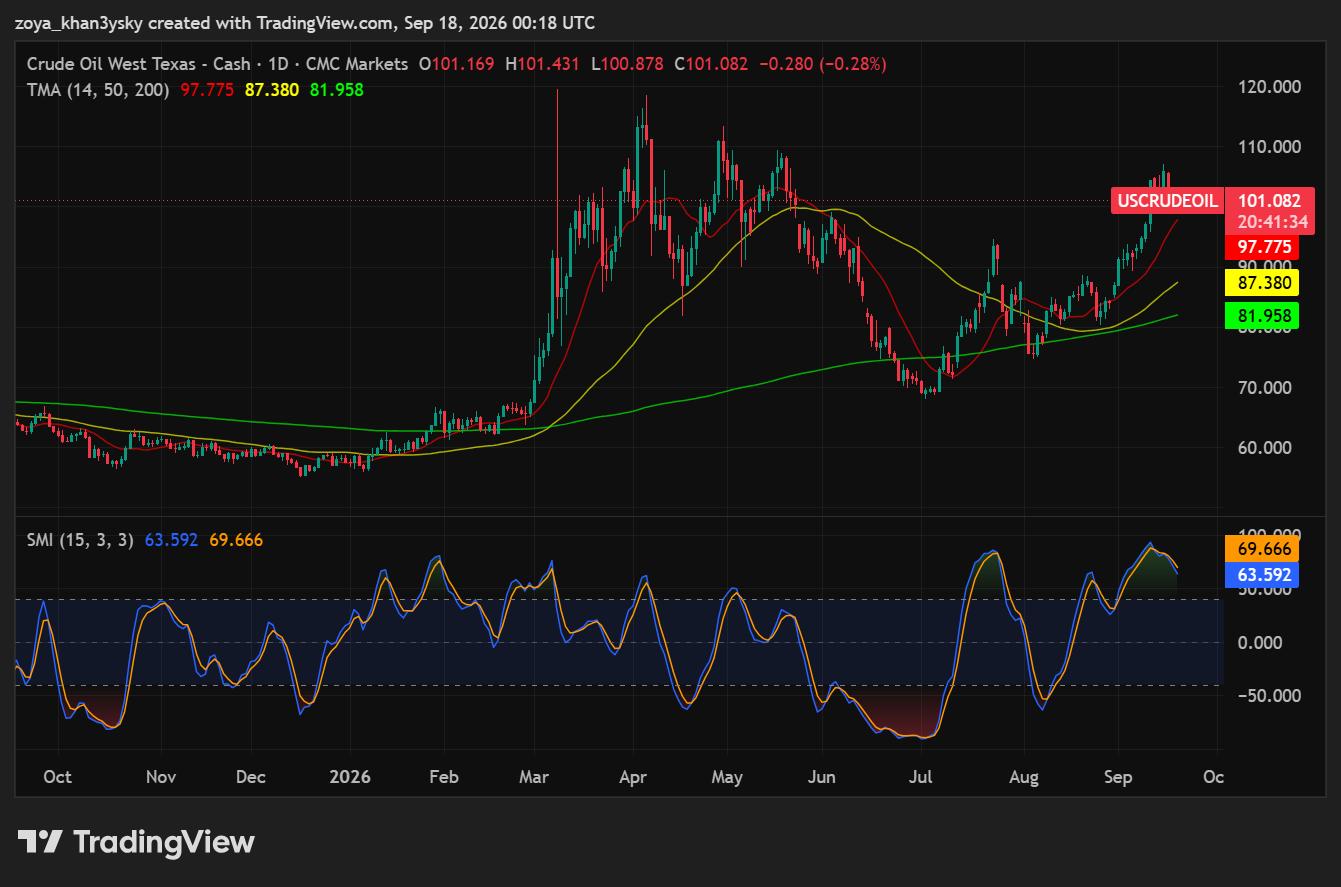
 Daily Chart: Longer-Term Bias: Bullish
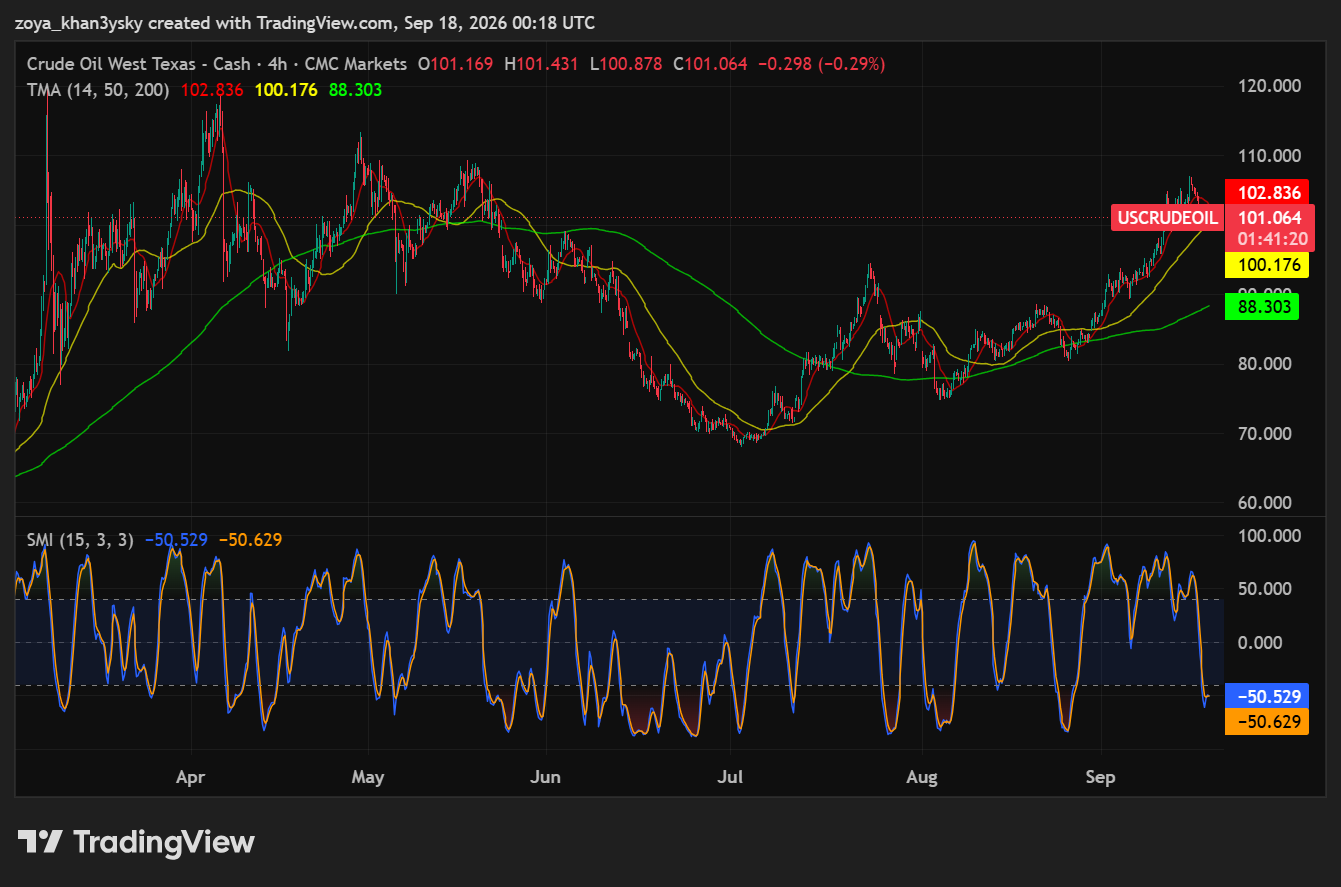
4-Hour Chart: Short-Term Outlook: Neutral
Friday 18th September
The daily chart shows crude oil in a well-established recovery, having based out in the 75–80 range mid-year before staging a sustained advance back to current levels near $101. Price is now trading above all three moving averages — the 14-day (97.78), 50-day (87.38), and 200-day (81.96) — a bullish “stacked” alignment where each shorter MA sits above the next longer one, confirming that the uptrend has strengthened across multiple timeframes and that these averages should now act as layered support on any retracement, with the rising 200-day line in particular marking the line in the sand for the broader trend. The Stochastic Momentum Index is reading firmly positive at 63.6/69.7, having pushed into overbought territory as the rally accelerated in September; this doesn’t necessarily signal an imminent reversal on its own, but combined with the fact that price has now rallied well above its 50-day MA without a meaningful pullback, it does raise the risk of a near-term momentum divergence if the SMI rolls over while price continues to grind higher — that would be an early warning that the advance is losing steam even as new highs are made. For now, the trend remains intact and traders should look for a continuation toward the 110.00 area (the prior swing high from earlier in the year), with a further extension possible toward 120.00 if that level gives way. A stop loss placed below 97.00, under the 14-day MA, is recommended to protect long exposure while giving the trade room to breathe through normal volatility.
On the 4-hour timeframe, the picture is more nuanced: price ($101.06) is essentially straddling the 14-period MA (102.84) and sitting just above the 50-period MA (100.18), both of which have curled higher over the past several weeks as the rally off the July/August base gathered pace, while the 200-period MA (88.30) remains well below current price, underscoring the strength of the intermediate-term move. However, the Stochastic Momentum Index is currently reading negative (-50.5/-50.6), which stands in clear contrast to the price action near multi-month highs — this is a textbook bearish momentum divergence, where price continues to press higher (or hold near highs) while the momentum oscillator fails to confirm with commensurate strength, typically signaling that buying pressure is fading on this shorter timeframe even if the larger trend remains up. This divergence argues for caution on new short-term longs and supports a neutral stance until momentum realigns with price: a push back above the 14-period MA at 102.84 with the SMI turning higher would reassert short-term bullish control and open the way toward 110.00, whereas a break below the 50-period MA at 100.18 would suggest the divergence is resolving to the downside, exposing a deeper pullback toward the rising 200-period MA near 88.30. Given the conflicting signals, a stop loss just below 99.50 is recommended for existing long positions, tight enough to respect the divergence warning while allowing for normal 4-hour chart noise.
Daily Chart: Longer-Term Bias: Bullish
4-Hour Chart: Short-Term Outlook: Neutral
Thursday 17th September
WTI crude’s daily chart shows a decisively bullish trend structure, with price at 102.048 trading above all three moving averages in a fully bullish stack — the 14-day (red, 96.812), the 50-day (yellow, 86.814), and the 200-day (green, 81.749) — confirming the powerful multi-month advance off the July low near 70.00 that has carried the market roughly 45% higher. The rising 200-day average, which only recently crossed above the flatter early-year base, now marks a strong long-term support floor, while the 14-day average at 96.812 has become the first line of dynamic support that price has repeatedly used as a springboard on pullbacks through August and September. The key caution flag is momentum: the Stochastic Momentum Index is deep in overbought territory (72.335/76.439), a reading that historically has preceded consolidation or corrective pullbacks in this instrument (as seen after the January and April overbought spikes), so while the trend remains firmly up, the risk of a near-term pause or partial retracement is elevated even without an outright bearish divergence yet showing on price. Immediate resistance sits at the prior swing high near 110.00 from earlier in the year, with a stretch target toward the psychological 120.00 level if the rally extends; on the downside, a pullback that breaches the 14-day average at 96.812 would likely find secondary support at the 50-day average near 86.814. Given the strong trend but overbought momentum, traders should favor buying dips toward the moving-average cluster rather than chasing strength here, with a protective stop placed below 86.814 to guard against a deeper corrective move that would undermine the bullish structure.
The 4-hour chart shows a short-term pause within the broader uptrend, with price at 102.012 sitting just below the 14-period moving average (red, 103.837) after tagging a local high near 105 earlier in the session, while remaining comfortably above both the 50-period average (yellow, 99.117) and the 200-period average (green, 87.705) — a moving-average configuration that still favors buyers on any dip into that support band. This modest stall below the 14-period average follows an aggressive push higher off the late-August base, and the Stochastic Momentum Index has cooled from overbought territory back toward a neutral-to-mildly-negative reading (-10.265/-28.972), reflecting fading short-term momentum and a divergence between the still-elevated price level and the retreating oscillator — a classic sign that the sharp leg up needs to digest gains before its next move. Immediate resistance is at the 14-period average near 103.837, and a decisive close back above it would reopen the path toward the 110.00 daily resistance zone; failure to reclaim that level keeps price vulnerable to a deeper pullback toward the 50-period average at 99.117, with a break of that support exposing the 200-period average near 87.705 as the next line of defense. Given the neutral momentum reading within an otherwise intact uptrend, the near-term bias leans cautiously bullish on dips rather than outright bearish, and traders holding long exposure should place a stop below 99.117 to protect against a more meaningful momentum shift, while a break below that level would shift the short-term outlook toward neutral-to-bearish.
Wednesday 16th September
WTI’s daily chart shows a powerful uptrend reasserting itself after the sharp decline that took price from the January spike-high (which briefly touched the low-120s before collapsing) down to a summer low near 78 in July. Since that low, price has rallied in a near-uninterrupted climb back through all three key moving averages — the 14-day (95.73), 50-day (86.28), and 200-day (81.55) — and this stacked bullish alignment, with the shorter-term averages sitting above the longer-term ones, confirms the recovery has real trend strength rather than being a short-lived bounce. Current price at 105.04 is pressing against the upper end of the February–April consolidation zone, with immediate resistance at 105.79 (today’s high) and a more significant target at 113.00, the area that capped the market before the earlier breakdown. The Stochastic Momentum Index is deeply overbought at roughly 83–84, its highest reading since the January blow-off top — because price and SMI are climbing together here, this is trend confirmation rather than bearish divergence, but the extreme reading does raise the odds of a near-term pause or pullback rather than an immediate breakout. A constructive approach favors staying with the trend while being mindful of overbought risk: an upside push toward 113.00 is the primary target, with a stop loss placed below the 14-day MA at 95.73 to protect against a momentum-driven reversal, or a tighter stop near 100.00 for traders wanting to reduce exposure to a snapback from these overbought levels.
On the 4-hour timeframe, the same recovery structure is visible in finer detail — price has moved decisively above the 14-period (103.47), 50-period (97.70), and 200-period (87.13) moving averages, and the wide spacing between the 50- and 200-period lines reflects the strength of the move up from the July lows. Price is currently consolidating just under its recent high, with immediate resistance at 105.79 and a further extension target near 110.00 if the advance continues; a break of 105.79 would likely open a fairly clean path toward that level given the absence of much overhead supply in this zone. The 4-hour SMI reads around 61–64, elevated but well short of the 90+ extremes it reached at prior local tops (April, June, and August peaks), meaning there’s still some room for upside momentum before the indicator flags exhaustion — this is a supportive rather than warning signal at present. Short-term traders can look to buy pullbacks toward the 14-period MA at 103.47, with the 50-period MA at 97.70 as a deeper support zone if the pace of the rally slows; a stop loss below 97.70 would sit beneath both short-term moving averages and protect against a break in the current uptrend structure, while a move back above 105.79 would reinforce the bullish case and open the door to the 110.00 target.
Tuesday 15th September
WTI crude is in a firmly bullish longer-term posture, having broken decisively out of the 82–100 consolidation range that dominated trading from June through August and pushed to a fresh multi-month high near 102.967. Price is now trading above all three moving averages in properly stacked bullish order — the 14-day at 94.036 (red), the 50-day at 85.629 (yellow), and the 200-day at 81.308 (green) — a configuration where each shorter average sits above the next-longer one, confirming that trend momentum is aligned across timeframes rather than just a short-term spike. The 14-day average at 94.036 is the most relevant near-term support, having been tested and held during the recent pullback before the latest leg higher; a loss of this level would shift focus down to the 50-day at 85.629, which also marks the top of the prior basing range and would need to hold to preserve the bullish structure. The Stochastic Momentum Index is pinned at 79.870/81.631, deep in overbought territory, and importantly it is largely tracking price rather than diverging from it — momentum has expanded in step with the breakout rather than lagging behind it, which is a bullish confirmation signal rather than a warning of exhaustion, though the elevated reading does raise the odds of a near-term consolidation or shallow pullback before the next advance. Given the aligned moving averages and confirming (non-divergent) momentum, the daily bias favors continued strength, with an initial target near the psychological 105.000 level and a longer-term objective around 110.000 if the breakout extends; a stop loss placed below the 14-day average near 94.000 would protect against a failed breakout while still allowing room for normal volatility.
The 4-hour chart mirrors the daily’s bullish tone, with price having broken cleanly above the moving-average cluster that had capped rallies since April and now trading at fresh highs around 102.909, right at the current resistance ceiling. The 14-period average at 102.077 (red) is tracking tightly beneath price and now represents the first line of short-term support — its close proximity to spot price reflects the strength and persistence of the current move, since a fast-rising short average hugging price is typical of a strong, low-pullback trend. The 50-period average at 96.146 (yellow) and the 200-period average at 86.543 (green) remain well below price and continue to slope upward, reinforcing that the intermediate-term trend structure is intact and providing a deeper support cushion in the event of a sharper retracement. The Stochastic Momentum Index reads 40.211/43.594, a moderate positive reading rather than an overbought extreme, which is notable given how far price has already rallied — this gap between strong price action and only moderate momentum readings suggests the advance still has room to run before becoming overextended, with no bearish divergence currently visible since both price and the oscillator have been making higher highs together. Immediate resistance sits at the recent high near 102.909, with a breakout above that level opening the way toward 105.000; on the downside, support is seen at the 14-period average near 102.077, with a deeper support zone at 96.146 if the current advance stalls. Traders leaning with the short-term bullish trend would typically look to a stop below the 14-period average near 101.50–102.00 to manage risk against a sudden reversal.
Monday 14th September
The daily chart shows crude oil in a strong sustained uptrend, having climbed from the low-70s in July to a fresh push above 103 today, with a clean stack of moving averages — the 14-day TMA at 92.65 above the 50-day at 85.05 above the 200-day at 81.10 — confirming trend health, since all three are rising and properly ordered beneath price. Price has broken decisively above its recent August/September consolidation range and is now pressing toward the February highs near 110–113, an area where the last major supply zone formed before the sharp reversal earlier in the year. The Stochastic Momentum Index sits at 83/85, deep in overbought territory, and is closely tracking the price advance rather than showing bearish divergence, so the current strength appears to be genuine trend momentum rather than a fading move — though the overbought reading does raise the odds of a near-term pause or shallow pullback before the next leg higher. An upside target near 110, extending to 118 if the breakout sustains, looks reasonable given the measured move off the prior range. A pullback toward the rising 14-day TMA at 92.65, and more importantly the 50-day at 85.05, would still preserve the bullish structure, so a stop loss placed below 85.00 protects against a genuine trend change while giving the position room to breathe through normal volatility.
On the 4-hour timeframe, price has broken cleanly above all three moving averages — the 14-period TMA at 100.17, the 50-period at 94.75, and the 200-period at 85.96 — with the sharp, near-vertical rally since early September confirming aggressive short-term buying pressure and a bullish stacked-average setup. The Stochastic Momentum Index reads 27.46/28.68, still in neutral-to-positive territory rather than overbought, which is notable given how strong the recent price advance has been — this gap between a strong price move and only moderate momentum readings suggests there may still be room to run before the rally becomes stretched. Immediate resistance sits at the intraday high near 103.70, with continuation potential toward the 110 daily resistance zone if buyers stay in control. Support has shifted up to the 14-period TMA at 100.17, with a deeper cushion at the 50-period TMA near 94.75 should momentum cool. Traders leaning long could use a stop below 94.75 to stay protected against a reversal while allowing the trade room within the current uptrend structure.
Friday 11th September
WTI has staged a powerful advance off its July low near 71, recently accelerating through all three moving averages: price at 103.67 is now well above the 14-day MA at 91.37 (red), the 50-day MA at 84.44 (yellow), and the 200-day MA at 80.89 (green), with all three stacked in bullish sequential order below current price — a textbook alignment for an established uptrend. The 200-day MA’s steady upward slope since around June also confirms the longer-term trend has turned decisively higher after the multi-month decline from the January peak near 110–116. Momentum strongly supports this move: the SMI is at 93.24/90.55, deep in overbought territory, and has been climbing in tandem with price rather than diverging from it, meaning there’s no bearish divergence warning here yet — the trend and momentum are aligned. That said, an SMI reading this extreme (above 90) historically doesn’t sustain for long on this chart without at least a pause or shallow pullback, so upside chasing here carries above-average mean-reversion risk even within an intact uptrend. Resistance sits first at the recent high of 104.84, with the more significant target being the January/February spike zone around 110, which was the prior major swing high before the correction began. On the support side, the 14-day MA at 91.37 is the first level that would need to hold on any pullback, with 84.44 (50-day MA) as the deeper support that aligns with the broader base built over June–August. A stop loss placed below 91.37 would protect against a failed breakout while still allowing room for normal volatility within the uptrend.
The 4-hour chart mirrors the daily’s bullish structure, with price at 103.66 having broken sharply above the 14-period MA at 97.86 (red), the 50-period MA at 93.24 (yellow), and the 200-period MA at 85.39 (green) — a steep, near-vertical move off the August base that reflects strong short-term buying pressure. This kind of separation between price and the shorter MAs is typical of an impulsive breakout phase rather than a steady grind, which raises the odds of a retracement back toward one of those MAs before the next leg higher. The SMI here is at 85.08/81.43, also firmly overbought and rising in step with price — again no bearish divergence present, so momentum is confirming rather than warning against the current thrust, though the extremity of the reading suggests the move is due for at least a consolidation pause. Immediate resistance is at the 104.84 high, with continuation potential toward the 108–110 zone that capped previous rallies earlier in the year; on the downside, first support is the 14-period MA at 97.86, a level that has acted as a springboard on prior pullbacks during this uptrend, with 93.24 (the 50-period MA) as the more important secondary support that would need to hold to keep the short-term bullish structure intact. A stop loss below 97.86 balances protecting against a sharp reversal while giving the trade room to breathe through normal 4-hour volatility.